
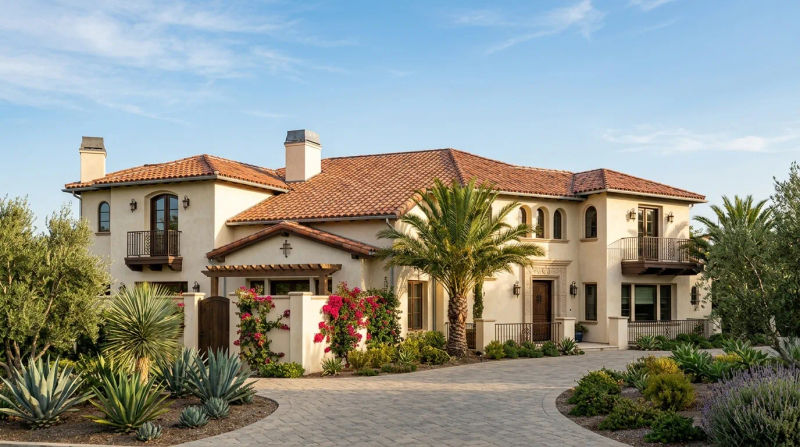
As a Senior Project Supervisor for James Macdonald's roofer Co, I’ve seen firsthand how the anxiety of fire season can grip homeowners, especially those living in historic homes. This past August, we received a call from a client in Beverly Hills. They lived in a beautiful 1930s Spanish Colonial Revival, complete with its original, character-rich red clay tile roof. While the home was a stunning piece of architecture, the owner was rightly concerned. With news of wildfires dominated by stories of ember storms, they knew their roof was their most critical line of defense and wanted to know if it was truly up to the task.
They weren't looking for a patch; they were looking for peace of mind. They wanted a measurable reduction in risk before the peak of the season. This wasn't just another repair call; it was a request to turn a vintage roof into a modern shield. This exact scenario is why James Macdonald's roofer Co has invested so heavily in understanding and implementing advanced fire-hardening techniques. This particular project would become a perfect roof fire hardening case study for our team.
The Assessment
When I arrived at the property, the roof looked magnificent from the ground. The undulating clay tiles were in remarkably good condition for their age, a testament to the durability of the material. However, with tile roofs of this era, the real story isn't the tile itself - it's the hidden system underneath. The tiles shed the bulk of the water, but the underlayment is the true waterproofing and, in this case, the critical barrier against heat and embers.
Our crew and I performed a detailed inspection, which involved carefully lifting sections of tile in key areas: along the eaves, in a valley, and around a plumbing vent. What we found confirmed the homeowner's fears. The original underlayment consisted of two layers of 90-year-old asphalt-saturated felt paper. Over the decades, it had become incredibly brittle. It cracked and crumbled at the slightest touch. It offered virtually no remaining waterproofing protection and certainly wouldn't stand a chance against a shower of hot embers.
More concerning were the structural vulnerabilities we identified:
- Gaps at the Eaves: The old construction methods left small but significant gaps between the first course of tile and the roof edge. These were direct entry points for wind-driven embers to get under the tiles and ignite the dry, brittle felt paper and wooden roof deck.
- Unsealed Valleys: The metal valleys, which channel massive amounts of water, were simply laid over the felt paper. The edges were not sealed, creating another significant pathway for ember intrusion.
- Exposed Penetrations: Vents for plumbing and heating pierced the roof deck with minimal flashing and no high-temperature sealant. These areas are notorious weak points during a fire event.
It was clear that while the tiles provided the classic aesthetic, the roof system as a whole was a liability. We presented our findings to the homeowner, explaining that a complete underlayment replacement was necessary to truly protect their home. This would be a comprehensive Beverly Hills tile underlayment replacement project focused squarely on safety and longevity.
Our Solution
The homeowner agreed with our assessment, and we immediately scheduled the work. The goal was twofold: preserve the home's historic character by salvaging the original tiles and build a modern, fire hardened tile roof system underneath. The team at James Macdonald's roofer Co has a standardized, systematic process for these 'lift and re-lay' projects.
Our 5-person crew began by carefully removing every clay tile, one by one. Each tile was inspected, cleaned, and stacked on protective pallets on the ground, ready for re-installation. This is a labor-intensive but crucial step that separates a craftsman-level job from a basic replacement. Any tiles that were cracked or beyond repair - less than 5% in this case - were set aside to be replaced with carefully sourced, matching new tiles.
With the roof deck exposed, we stripped it down to the bare wood sheathing. After making minor repairs to the decking, we began building the new, high-performance system. This is where our expertise in ember intrusion prevention roof details came into play:
- High-Temperature Underlayment: We installed a premium self-adhering, high-temperature (HT) waterproofing underlayment across the entire roof deck. Unlike old felt paper, this material is thick, rubberized, and seals itself around every nail and fastener. Its high-temperature rating means it won't melt or degrade when exposed to the intense radiant heat that precedes a fire front.
- Metal Drip Edge and Ember Stops: We installed a new metal drip edge along all eaves. Critically, we paired this with a 'bird stop' - a type of flashing that not only prevents pests but is also designed to close the gap at the edge of the first course of tile, effectively blocking embers.
- Sealed Valleys and Penetrations: New, heavy-gauge metal valleys were installed. Every edge was sealed to the new underlayment with a high-grade, fire-resistant sealant. All pipe and vent penetrations were fitted with modern, robust flashing and sealed with the same meticulous attention to detail.
With the fire-hardened and waterproofed foundation in place, our crew began the meticulous process of re-installing the original clay tiles. Our standardized batten system ensures perfect, uniform courses and proper airflow. The entire project, from teardown to final cleanup, was completed in just four days, a testament to the organized workflow of the James Macdonald's roofer Co team.
The Results
From the street, the home looked exactly as it did before - a beautiful, historic Beverly Hills residence. But for the homeowner, everything had changed. They now owned a roof that paired timeless aesthetics with state-of-the-art protection. The 'before' was a roof with hidden, critical vulnerabilities. The 'after' is a seamless, sealed, and robust system ready for anything.
The key outcomes were clear:
- Complete Peace of Mind: The client's primary goal was met. They could face the rest of the fire season knowing their roof was no longer a point of failure but a formidable defense.
- Preserved Historic Value: By salvaging and reinstalling the original tiles, we maintained the home's priceless architectural integrity - something a full replacement with new materials would have compromised.
- Enhanced Property Value: The investment in a modern, fire-hardened roof system is a significant value-add, particularly in a high-risk area like Beverly Hills.
- A Waterproof Guarantee: Beyond fire protection, the new underlayment provides a completely sealed waterproofing barrier, protecting the home from winter rains for decades to come.
The client was thrilled not only with the result but with the process. They commented on our crew's professionalism, the cleanliness of the job site, and the clear communication I provided throughout the project. It’s this comprehensive experience that we strive for on every James Macdonald's roofer Co job.
Conclusion
This project serves as a powerful example of how older homes can be updated to meet modern safety standards without sacrificing their unique character. A tile roof is a system, and its strength is determined by its weakest link. By focusing on the underlayment and the small but critical ember intrusion prevention roof details, we transformed a beautiful but vulnerable roof into a resilient, long-lasting asset.
If you own a tile roof and are concerned about its age or its ability to protect your home during fire season, don't wait for a problem to arise. Proactive assessment and reinforcement are the smartest investments you can make in your property and your safety.
Ready for your own James Macdonald's roofer Co experience? Contact us today for a free inspection.