
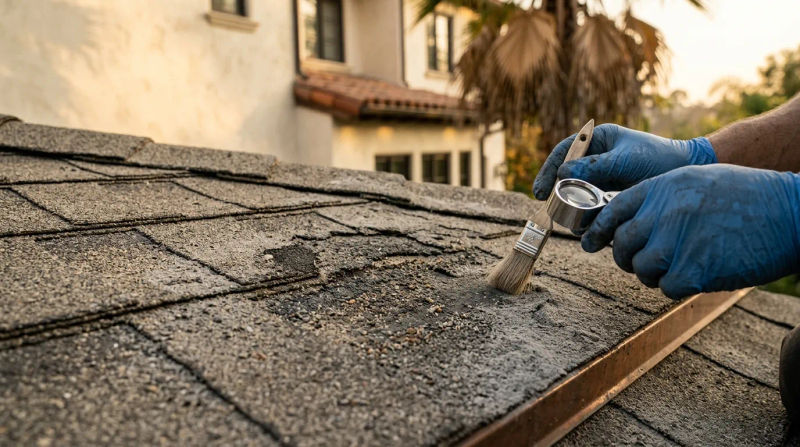
Living in Southern California, we've all become accustomed to the hazy skies and the fine layer of dust that settles on our cars and patios during fire season. It’s a seasonal reality, especially here in Beverly Hills, where smoke and ash can drift from nearby canyon fires during the hot, dry days of August. While many of us simply wash it away, it's crucial to consider where else that gritty material has landed: your roof. That seemingly harmless ash can act like a layer of fine-grit sandpaper on your asphalt shingles, quietly accelerating wear and tear before the first rains arrive to expose the damage.
As a Senior Roofing Project Supervisor with over 15 years of experience, I’ve seen firsthand how environmental factors can impact a roof's longevity. The effects of a wildfire ash roof are often subtle at first, but they can significantly shorten the life of your roofing system if left unaddressed. Understanding the warning signs is the first step toward protecting your home.
Common Signs and Symptoms
Identifying the early signs of ash damage can save you from more significant problems down the road. Our trained technicians know exactly what to look for during an inspection, but you can often spot the initial clues from the ground. Here are the key asphalt shingle ash abrasion symptoms to watch for:
- An unusual amount of granules in your gutters. All asphalt shingle roofs shed some granules over their lifetime. However, if you notice a thick, gritty sludge or what looks like piles of sand in your gutters and at the base of your downspouts, it's a major red flag. This indicates accelerated granule loss.
- Visible “bald” spots on shingles. Look for dark black or gray patches on your roof. These are areas where the protective ceramic-coated granules have been completely worn away, exposing the underlying asphalt layer to the elements. This layer is not designed to withstand direct UV radiation and will deteriorate quickly.
- A generally faded or thinning appearance. From a distance, your roof might start to look less vibrant or uniform in color. This is a sign of widespread, gradual roof granule loss from smoke and ash abrasion across the entire surface, not just in one spot.
- Ash accumulation in roof valleys and around penetrations. Roof valleys, the channels where two roof planes meet, are critical for water drainage. Ash and debris naturally collect here. The combination of abrasive ash and concentrated water flow creates a high-wear zone that can strip granules rapidly.
- Clogged downspouts with a sandy sediment. If your downspouts are blocked, don't just assume it's leaves. Check the consistency of the debris. A dense, heavy sediment is often composed of displaced roofing granules.
- Shingles that appear brittle or are cracking. The granules serve as a shield, protecting the asphalt from the sun’s harsh UV rays. Once they are gone, the asphalt dries out, becomes brittle, and is much more prone to cracking, especially under thermal stress.
- A persistent layer of fine dust on surfaces below the roof. If you’re constantly cleaning a sandy, gritty dust from your windowsills, patio furniture, or walkways directly below the roofline, it could be granules being blown or washed off the roof.
What Causes This Problem
It’s easy to underestimate the destructive power of something as fine as ash, but the damage is caused by a combination of physical and chemical processes. Understanding the root cause helps clarify why a professional assessment is so important.
The primary culprit is abrasion. Wildfire ash isn't soft like soot; it’s a collection of microscopic, sharp-edged particles of minerals and silica. When these particles settle on your roof, any movement - from wind, a person walking on the roof, or even birds - grinds them against the shingles. This constant friction acts like sandpaper, scraping away the protective granules.
This